MadridSquare
Plaza de Oriente, Madrid: royal statues, gardens and a walking route

The short answer
Plaza de Oriente is more than a foreground for the Royal Palace. Its clipped gardens, lines of monarchs and opera house explain how Madrid made a ceremonial space out of this part of the city. Walk from Ópera around the theatre, explore the three garden areas, then choose a palace-side extension or the smaller streets towards San Ginés.
Who it suits, who should skip it
Good for
- Visitors interested in public gardens and royal sculpture
- Walkers linking Ópera with the palace exterior
- People who want a compact outdoor route before a separate cultural visit
Skip it if
- A walk through the square does not include palace or theatre admission
- Theatre tour routes can change with technical and organisational needs
- The suggested walking route has not been surveyed for continuous step-free access
Why Oriente is on Madrid’s western side
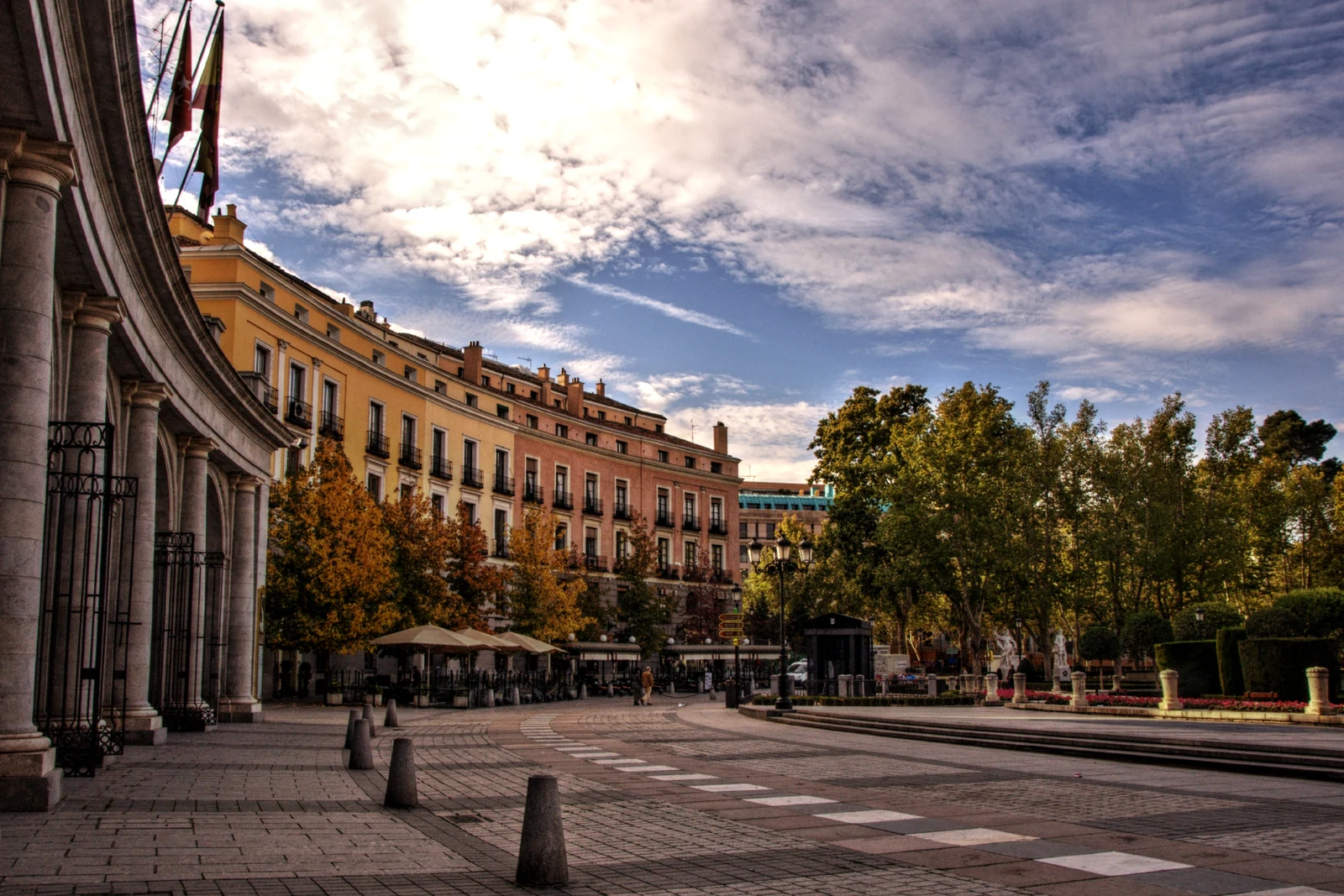
The name describes the square’s position east of the Royal Palace, not its position within Madrid. Stand near the theatre and look across the planting towards the palace façade: the public space was designed to frame that view. The layout settled into its nineteenth-century form under architect Narciso Pascual y Colomer in 1844, then changed again in the 1997 remodelling led by Miguel de Oriol.
Three different garden spaces reward a circuit rather than a single photograph. The central parterre uses clipped geometric planting around the equestrian monument. Cabo Noval occupies the north side beside Calle de San Quintín; Lepanto is to the south. Compare their tree-filled spaces with the more formal centre.
Look beyond the horse and rider
Philip IV is the rider at the centre of the square. Pietro Tacca cast the bronze in 1640, long before the present square took shape. Around it, the standing royal figures make sculpture part of the garden rather than decoration confined to a palace wall. Look at the monument from the sides as well as head-on to see the horse’s raised forelegs.
Across the square, Teatro Real represents another chapter in the area’s history. It opened in 1850 and reopened as an opera house in 1997 after a long sequence of closures and different uses. If the building interests you, choose a theatre tour separately: the operator distinguishes general, audio-guided and backstage visits, and warns that some routes may change for operational reasons.
A walk from Ópera to the palace frontage
Start in Plaza de Isabel II outside Ópera station. Walk around the outside of Teatro Real to reach Plaza de Oriente, then follow a garden circuit through Cabo Noval, the central statue area and Lepanto. Finish on the Calle de Bailén side to see the palace façade across the open space. This is a suggested sequence, not a timed or guided tour.
For more outdoor walking, continue north towards the Sabatini Gardens and Plaza de España rather than trying to enter every major building. The city describes a pedestrian connection between these spaces following the Plaza de España works. Garden entrances and any temporary restrictions still need checking; a linked district does not mean every garden is open at every hour.
Café culture on the square, chocolate in a side passage
Café de Oriente, at number 2, adds a different layer to the square’s history. Founded in 1983, it occupies vaulted spaces associated with the former Convent of San Gil. The city’s tourism office also records illustrator Antonio Mingote’s connection with the café. It is an example of the area’s café culture, not a required stop or a promise about the current menu.
For a sweet-food extension, return towards Plaza de Isabel II and follow Calle del Arenal towards Pasadizo de San Ginés. The chocolatería there has served chocolate with churros since 1894, and its history includes customers arriving after theatre performances. Chocolate con churros pairs a thick drinking chocolate with fried dough; check the current menu and ingredients rather than treating it as a substitute for a full meal.
Arrive at Ópera and keep interiors separate
Ópera station serves Metro Lines 2 and 5 and the Ramal connection with Príncipe Pío. The transport authority lists its street entrances and lift in Plaza de Isabel II, on the theatre’s opposite side from the palace. Use the station exit that fits your needs and check current lift and service information before travelling.
The square works as an outdoor visit in its own right. If you also want the Royal Palace interiors or a performance at Teatro Real, organise those as separate visits and follow the venue’s entry instructions. Do not assume that the façade facing the square is the entrance required by your ticket.
Where it is
The area this guide covers: This guide covers Plaza de Oriente between the Royal Palace and Teatro Real, including the adjoining Cabo Noval and Lepanto gardens. The optional San Ginés food stop lies outside the square; this is not a guide to the whole Palacio neighbourhood. An editorial outline, not an official district line.
Nearby
Mapped sights nearby
- A los héroes del 2 de mayo 1808
- Real Cocina de Palacio
- Ataúlfo
- Eurico
- Sancha de León
- Fernando I
- Suintila
- Leovigildo
More street guides nearby
How these numbers were measured
| Sampled point | Elevation |
|---|---|
| Plaza de OrienteThe anchor: distances on this page start here | 635 m |
| North ring sample | 627 m |
| North-east ring sample | 657 m |
| East ring sample | 655 m |
| South-east ring sample | 658 m |
| South ring sample | 644 m |
| South-west ring sample | 619 m |
| West ring sample | 594 m |
| North-west ring sample | 622 m |
- Mapped venue counts do not measure noise. Noise-risk ratings, formula-based walking times and unverified transit classifications are not shown.
- Distances are straight lines from the guide anchor, not walking routes or journey times.
- Elevations from Copernicus DEM GLO-90 via the Open-Meteo Elevation API are sampled ground heights, not route ascent. Terrain models have limited resolution.
- Map observations recorded on 13 Oct 2026. Map coverage may be incomplete.
Questions and answers
Why is Plaza de Oriente called Oriente?
It lies east of the Royal Palace, although this is the western side of central Madrid.
Who is the rider in Plaza de Oriente?
The central equestrian statue depicts Philip IV. The bronze was cast by Pietro Tacca in 1640, before the square received its nineteenth-century layout.
Which metro station serves Plaza de Oriente?
Use Ópera on Lines 2 and 5 or the Ramal. Its entrances are in Plaza de Isabel II; walk around Teatro Real to reach the gardens.
Can you explore Plaza de Oriente without visiting the palace?
Yes. The gardens, sculpture and exterior views form a separate walk. Palace interiors and theatre visits need their own planning.


