SevilleNeighbourhood
Alameda de Hércules, Seville: columns, cafés and a walk to Feria

The short answer
Alameda de Hércules is a long open promenade in the northern old town, not an enclosed monument square. Come for the reused Roman columns, cafés and the cultural life around them, then continue towards Feria’s market or Santa Clara. Its story runs from a drained lagoon to a public walk and a meeting place for Seville’s LGBTQ+ community.
Who it suits, who should skip it
Good for
- Visitors interested in public-space history, Roman fragments and the city beyond its cathedral circuit
- Walkers combining the Alameda with Feria’s food market and the Centro del Mudéjar
- People looking for cultural venues and cafés without needing a scheduled event
Skip it if
- Do not plan around a particular concert or market without checking its current programme
- Choose the open promenade alone if you do not want to add the narrower surrounding streets
- Check venue access separately if an interior visit is essential to your day
Read the history in the two pairs of columns
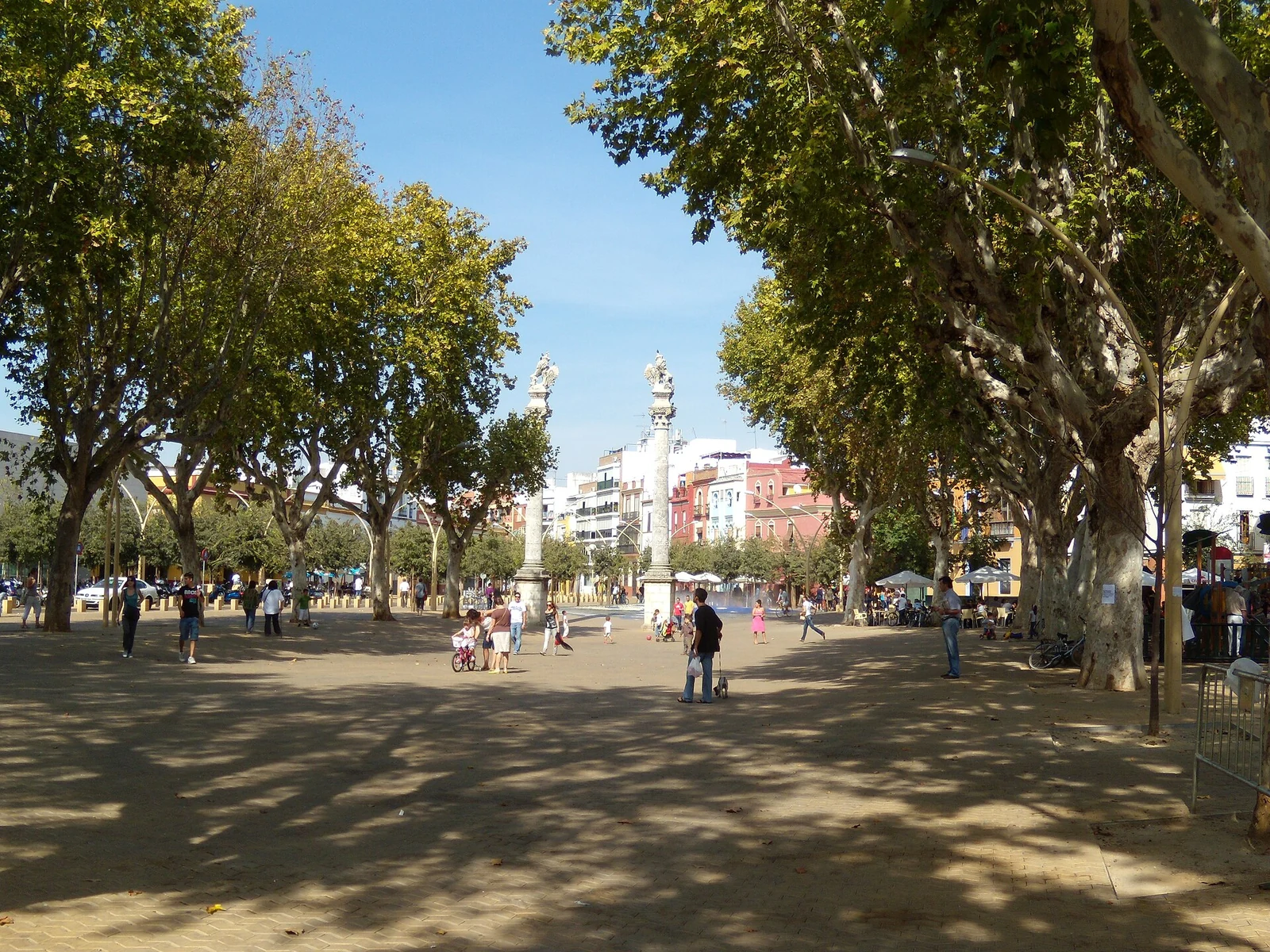
The Alameda was created in 1574 when the Count of Barajas had a marshy lagoon drained to make a public promenade. At the southern end, two Roman columns brought from Calle Mármoles carry later statues of Hercules and Julius Caesar. The statues invoke Seville’s origin stories; the columns are reused ancient material, not a Roman monument standing in its original location.
Walk to the opposite end to see a different pair: eighteenth-century columns topped by lions holding shields. Comparing the two ends makes the space easier to understand than treating all four columns as one Roman ensemble. Between them, the broad open promenade is the attraction: it gives this part of the old town a different shape from the smaller squares around it.
Cafés, cultural life and the Feria food connection
The Alameda’s terraces and music venues are part of a wider cultural history. Seville’s tourism office identifies it as a centre of LGBTQ+ social life, shaped since the 1990s by bars, bookshops and associations. That is more useful context than calling it simply a nightlife district. A daytime walk still takes in the columns and the surrounding streets; an evening performance needs its own programme check.
For a food-focused extension, head towards Calle Feria and its covered market, beside Omnium Sanctorum church and the Palace of the Marqueses de la Algaba. The market brings fresh-food shopping and prepared food into the same outing: fish, vegetables and charcuterie are part of its identity, alongside newer cuisines. Check individual traders before planning a meal, rather than assuming the whole market follows one restaurant timetable.
A walk with one useful extension
Start at the Hercules and Caesar columns on the south side, walk the length of the Alameda to the lion-topped columns, then choose one branch. For food and architectural detail, turn towards Feria and finish around the market and the Palace of the Marqueses de la Algaba. Its Centro del Mudéjar displays ceramics, carved wood and plasterwork that explain the craftsmanship behind the palace’s Gothic-Mudéjar entrance.
For a cultural-venue visit instead, make Santa Clara on Calle Becas your western extension. The former convent is now a venue for exhibitions, music and other cultural events. Its cloister is a different kind of public space from the Alameda, but check the venue’s current access and programme before going. There is no need to squeeze both branches into a short visit.
Getting there and planning the return
From the Plaza del Duque area, Calle Trajano leads towards the southern end of the Alameda. Use the columns as your meeting point rather than just naming the entire promenade. For a bus journey, AppTUSSAM provides route maps, stops and service information for the date and time of travel. Check the stop closest to the part of the Alameda you want to reach.
Check the return journey separately if you stay for an evening event. This guide does not promise a particular departure, a direct connection from every station or step-free access through every side street. For the shortest visit, keep to the Alameda itself; the market, museum and Santa Clara have their own opening arrangements.
Where it is
The area this guide covers: The guide covers the Alameda promenade between its two pairs of columns, with optional walks east to Feria and west to Santa Clara. These are editorial walking connections, not official neighbourhood boundaries or a surveyed step-free route. An editorial outline, not an official district line.
Nearby
Mapped sights nearby
- Nuevas columnas de La Alameda
- Almeda de Hércules
- Sala Exposición Santa Clara
- Torre de Don Fadrique
- Palacio de santa coloma
- Palacio de los marqueses de la Algaba
- Monumento a Daoíz
More street guides nearby
How these numbers were measured
| Sampled point | Elevation |
|---|---|
| Alameda de HérculesThe anchor: distances on this page start here | 9 m |
| North ring sample | 14 m |
| North-east ring sample | 15 m |
| East ring sample | 15 m |
| South-east ring sample | 15 m |
| South ring sample | 15 m |
| South-west ring sample | 16 m |
| West ring sample | 15 m |
| North-west ring sample | 12 m |
- Mapped venue counts do not measure noise. Noise-risk ratings, formula-based walking times and unverified transit classifications are not shown.
- Distances are straight lines from the guide anchor, not walking routes or journey times.
- Elevations from Copernicus DEM GLO-90 via the Open-Meteo Elevation API are sampled ground heights, not route ascent. Terrain models have limited resolution.
- Map observations recorded on 14 Oct 2026. Map coverage may be incomplete.
Questions and answers
Are all four Alameda de Hércules columns Roman?
No. The southern pair reuses Roman columns transferred from Calle Mármoles and topped with later statues of Hercules and Julius Caesar. The northern pair, with lions and shields, dates from the eighteenth century.
Is Alameda de Hércules worth visiting during the day?
Yes, if you want to see the columns and promenade or connect the walk with Feria’s food market and the Centro del Mudéjar. Its cultural identity is broader than evening bars and performances. Check separate opening times for the market traders and museum.
How do I reach Alameda de Hércules?
From Plaza del Duque, approach the southern end via Calle Trajano. For public transport, consult the official AppTUSSAM route maps and check the date, stop and service notices. Use the southern columns as a precise meeting point.


